Tom Compaijen has years of experience in dealing with crises. He worked as a Crisis Coordinator for the Dutch ministry of Health and as a Crisis Communication Advisor for the City of Amsterdam. He was a member of various crisis teams, assembled for terroristic threats, major power cuts, IT failure, data breaches, the COVID pandemic, the MH17 airplane crash, major fires, the evacuation of the VU medical center hospital, and the visit of former President Obama to Amsterdam.
He advises and coaches organizations on crisis communication and crisis management: the Dutch ministry of Infrastructure and Water Management, the City of Rotterdam, UNESCO, the Dutch National Police, the Dutch Military, hospitals, Dutch Railways, Liander Utilities, RAI Amsterdam Convention Centre, Mauritshuis Art Museum, and ID&T Dance Festivals. Tom hosts a crisis podcast, shares crisis vlogs, and leads a crisis communication consultancy company.
He has done crisis training sessions in Washington dc, Brussels, and Sharjah in the United Arab Emirates. Tom is a media expert on crisis communication. He graduated in Neuro Sciences and applies this knowledge in his coaching and consulting. |
TABLE OF CONTENTS
Part 1: Welcome in the world of crisis communication
Introduction
How to recognize a crisis
Challenges in crisis communication
Welcome in the terminology of crisis communication
Starting points for good crisis communication
Part 2: The 7 Principles for good crisis communication
Lesson 1: If you don’t want to listen, you will feel the consequences
Lesson 2: It's not the crime, it's the cover up
Lesson 3: Thinking about your reputation is bad for your reputation
Lesson 4: Not choosing is a bad choice
Lesson 5: Action speaks louder than words
Lesson 6: No one is more intelligent than their emotions will allow
Lesson 7: Keeping quiet will lead to a tsunami of criticism
Part 3: Epilogue
Ready for every crisis
Acknowledgements
Sources
Glossary and abbreviations
Endnotes
About the author |

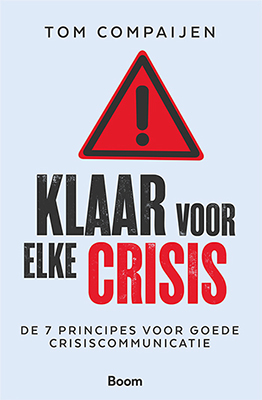

 Published in March 2024 | Paperback | 228 pages | ca. 60,000 words
 Full English translation available