|
|
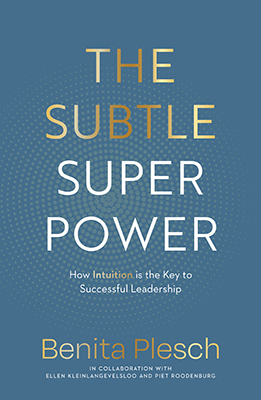
The Subtle Super Power |
| How Intuition is the Key to Successful Leadership |
leadership |
|
By combining intuition and leadership, this book provides a unique perspective. Not just for management and leadership, but for all types of leadership like teachers, artists, healthcare professionals, and civil servants, as well as anyone who is curious to learn more about intuition. How does leadership really work and what is the role of intuition in leadership? These were the questions with which Benita Plesch, medical biologist, leadership expert, and former Director General of the Dutch General Civil Service, started her journey. In most organisations intuition is usually not discussed. Yet, it is a natural skill that enables us to function in complex situations where it is impossible to know all the facts beforehand. It truly is a subtle super power for human interaction, vision, and collaboration. In The Subtle Super Power Benita Plesch invites the reader to open up for a talent that is hard to prove but easy to experience. Her aim is not to defend or explain intuition but to show how valuable it is to trust your intuition. No matter how tough the world around you is, your intuition can be your guide. The book is filled with facts, practical models, and research as well as inspiring anecdotes from C-level leaders in business, health care, the military, the arts, and government. And icons like Steve Jobs, Oprah Winfrey, and Nelson Mandela are quoted to show how they use their intuition. Other sources of information are an extensive leadership survey she conducted and examples from work areas where intuition is considered a valuable skill, like health care and the military. The leadership survey provided the surprising insight that all Level-5 leaders that were interviewed depended largely on their intuition, which is backed by Jim Collins’ findings in his groundbreaking bestseller Good to Great. They all are able to use both their rational thinking as well as their intuition. With her practical approach Benita has given us many arguments to trust and use our intuition. The book’s informal and engaging tone makes it easy and enjoyable to read. |
|
|
|
|
|
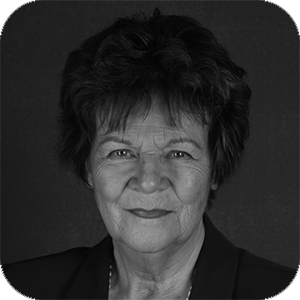
Benita Plesch was born in Manchester in 1948 and studied Medical Biology at the University of Bristol and the Free University (VU) in Amsterdam, where she obtained her PhD in 1973 and worked at the medical faculty. She made a switch in her career in 1981 and started working as an organisational advisor in the private sector and at the Dutch Ministry of Internal Affairs. In 1985 she became the director of Information, Automation and Organisation where her fascination with leadership really began. Her first discovery in that position was that she enjoyed leadership much more than she had expected because it revolved more around helping people and keeping them motivated and enthusiastic than the budgets and planning. Her scientific background urged her to search for a solid framework for her everyday actions but neither Public Administration nor Business Administration could provide what she was looking for. Not knowing what she was looking for exactly, Benita had started a journey of personal development, a quest to become the best possible version of yourself. This was when she began to discover the role of intuition and how experience offers a completely different learning method than consuming facts and figures, no matter how interesting. During her courses in which intuition played implicit or explicit roles, she found that her rational thinking kept searching for the facts and scientific foundation for intuition as a phenomenon that is often described as vague and soft. She started to better understand intuition, its workings and importance. After working as a director for a while Benita became Deputy Secretary-General for the Dutch Ministry of Internal Affairs and in 1995 she was appointed as the very first Director General of the newly established Senior Public Service. It was then the first of its kind in the Netherlands and it was intended to modernise the top of the Dutch governmental service and make it future-proof for the twenty-first century through leadership development and leadership mobility. In 2001 she bid farewell to the government and started a new chapter in her career as a consultant, coach and leadership trainer for the private sector, but her quest for the workings of intuitive leadership has never stopped. In 2002 she conducted a survey on how leaders learn, together with co-author Piet Roodenburg, which was the incentive to continue her search for answers and ultimately led to this book. |
Table of Contents Foreword by Harry Starren 1. Introduction: intuition, a soft skill Acknowledgements |
|
|


 Published in April 2026 | Paperback | 176 pages | ca. 39,000 words
 Full English translation available