|
|
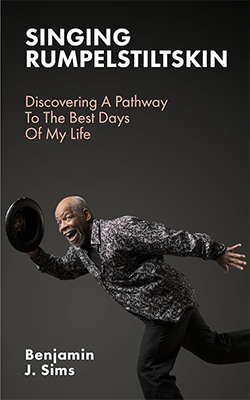
Singing Rumpelstiltskin |
| Preview - click here to go back to the book |
INTRODUCTION2021, Hilversum, the Netherlands People have said that I have a very interesting life, but I don’t see it that way. I see my life as being just as complicated and just as interesting as any other Black American that was raised in the United States. I don’t find it too interesting, but I do have a story to tell. And I have titled this book Singing Rumpelstiltskin. Singing Rumpelstiltskin refers to my first experience with racism or discrimination or how you want to call being judged based on the color of my skin. Not the content of my character nor the abilities I had to be an actor or a singer. Just based on the fact that at a predominantly white school, there was no reason to give me anything that meant that I was better than some white kid. I will tell more about this experience later on. Racism is something that I didn’t really notice in my life or around me until I was in my teens. There were words that had an effect on my life that I didn’t know existed. Most of these words are -isms, and they had a profound effect on my life as I got older. Such things as classism, sexism, racism, Confucianism, Catholicism, all the -isms that I am aware of now, it seems like we just didn’t have them back then. Another thing that has changed over time is how we called ourselves and how we were perceived by others. First we were called “negroes,” a term that was used when I was young to describe all people of color. And in segregated areas of the United States, the term “colored” was used to separate the conditions and facilities: colored bathrooms, colored entrances, etc. From the 1970s to the 1990s, the term “Black” was used, and this was given prominence by James Brown who demanded that we say it loud (and proud). In the late 1990s, the term “African American” surfaced in our search for identity and our African roots. And the word gained power with the election of Barack Obama in 2008. However, nowadays the term that has gained more usage is “people of color” which is more inclusive and strives for togetherness and survival in a world that tends to separate along various lines: color, religion, wealth, geography, and so on. Demographically, so many families are mixed or will become racially diverse that it is impossible not to have a conversation about inclusion and diversity. These days I try to use my experiences with racism to educate. Recently, I was sitting in the sauna in the gym where I work out almost every day, when in walks a man who recognizes me and says, “Hi Ben!” I knew this guy, he is white and from the UK, he’s been to a few shows of my current band, Soul Machine. He saw me sing and we talked about music. In the sauna we had a conversation about current events, the pandemic, immigration, drugs, and policing. Then he told that his son was arrested for drugs possession in Miami, Florida. He said that his son was framed for this, that the police had made up a story that wasn’t true, and that they had to pay $10,000 bail to get his son out of trouble. So he was upset, but I said, “That’s terrible, but be thankful that they didn’t beat your son, or worse, shoot him.” He understood that I referred to how Black people are being treated by the police in the United States and he said to me, “The only reason Black people get shot is because they all have smart mouths and won’t do what the police say.” So I asked if he believed that if you talk back to the police you should get shot? “No,” he said, “but if you don’t show your identification, then you are the problem.” “So, if the police arrest your son, you pay $10,000 bail, your son goes home, but if a Black kid fails to show his I.D., he goes to the morgue. Do you think that is equal treatment?” “Well, if you don’t have anything to hide, you can just show your identification.” Then I told him that according to our constitution, you have the right to due process and that all individuals have the right to refuse an unlawful order. He said, “I didn’t know that.” And I told him that the law in the United Kingdom is similar, and he said, “I didn’t know that because I have never been stopped by the police.” So I feel that my new role, at the age of 77, is to educate people who want to know how it feels to be a Black man in and from the United States of America. That is what this book is about. Chapter 1 A TALE OF TWO FAMILIES1940–1945, Hartselle, Alabama, US Even before I was born, my situation and the situation I was coming in to was based on classism. At no point was my mother supposed to be with my father. Her name was Mary Francis Battle, and she was an educated woman. And my father, James Edwin Sims, went to high school, but he was a farm boy. The father of my mother was a preacher and my father’s father was a farmer that came from the northern part of Alabama. Everything that he did was on the farm and everybody, my father, his brother and sisters, worked on the farm. And while Grandpa Battle had class, Grandpa Sims had a tendency to drink. My grandmother on my mother’s side was even a debutante and was highly educated, and she sang and played piano in the church. My grandmother on my father’s side was not overly educated, and she had to raise five girls and two boys, but she was just the warmest woman you could meet and she had what we would call mother’s wit or instincts and a sincere warmth about her. So my mother and father were from different social classes. Plus there was a difference in the skin color. My father was very dark, and you could see the African heritage in him. His father, my Grandfather Tobe, was a free man that owned his own property. He earned his money making moonshine, a home brew liquor, but he drank a lot of his wares and most of his profits. Grandfather Tobe would ride a white horse, and he would carry two pistols that he would fire at anyone that made him angry. Both my grandfather and his mother, my great-grandmother Mama Ella, had a darker hue than some of the family. My grandfather’s parents were slaves, and they had twelve children. Of those twelve, four were fairskinned with red hair and blue/green eyes: my granduncle Porter and my grandaunts Amanda (Mandy), Katie, and Holsie. All of them would live to be at least a hundred years old, and I had the opportunity to meet them all. It is probable that their father was the owner of the plantation, a Mr. Seay who might have been Irish. In the family, the lighter the skin, the more closely you were related to the white person. But the rest of my father’s family was very dark, and my father had a blue tinge to his dark skin. He had sort of a wide nose with beautiful white teeth. My mother had a totally different ethnic makeup; she was brown, but her mother was very, very light, and you could just see the white inheritance in her. Her father was very fair-skinned with dark wavy hair, and my grandmother was also very fair and you could see the native Indian in both of them. I did some research on my ancestry because they both looked very Indian and my grandmother had an Indian name, but the results showed that I only had 1% Indian blood. My parents came into the situation with my mother being the one that had a higher education and a lighter hue, but somehow my father was able to charm her. My mother was an only child while my father had one brother and five sisters. Daddy was smooth. He was a football player, basketball player, track guy, he sang in the choir, he had a wonderful smile, great white teeth, he was a ladies’ man. And Momma was college educated but she was kind of naïve and she was very spoiled as an only child. Everybody always did things for her, they called her Baby, and Daddy clearly picked up on that. When he was a singer in high school, Momma was his twelfth-grade English teacher — she was older than him, she had graduated from Talladega College and started teaching at Decatur High School, where my father was a student. She taught Girls’ Hygiene, coached the girls’ basketball team, and taught twelfth-grade English. Somehow he was able to get her attention to the point that she fell in love. I don’t know exactly what happened, but she fell in love with him. When my mother was young, she was a basketball player, she played point guard for Talladega College. And she was athletic and thin, but after she married my father, she really picked up weight. Another thing about my mother, when she was in college she was a singer and she had a beautiful contralto voice. The family story is that there was some kind of contest, and I don’t know if this is true or not, but I like to think it is because I love my mother. Famous gospel singer Mahalia Jackson and my mother were in a competition; they were two kids that could really sing, and rumor has it that my mother was considered the better singer of the two. My mother was a contralto but her voice had a range from bass to soprano. But her fame didn’t last long and lasted about all of five minutes after my father was able to woo her. He was a strong man and had massive arms from working on the farm. There is a story about my father that when he was about sixteen or seventeen, he was trying to get the horse to move to help pull the plough and the horse wouldn’t move. My father became so angry that he walked around to the front of the horse and just hit him in the forehead and knocked the horse to his knees. The horse sat there for a couple of seconds and then got up and started ploughing the field. They started calling my father Warhorse and that was his nickname, James Edwin Warhorse. He carried that name all through his life. There were people in Cleveland that he knew that used to call him Warhorse all the time. After they were married, my older sister Edwina came along in 1943, and I was born eleven months later. Daddy had joined the military in 1943, and when I was born he was stationed in or near Saipan, an island in the Pacific. But before he left, Momma left Alabama and went to Texas to be with Daddy while he was preparing to be sent out. She actually snuck off and nobody knew where she was going to, but she left Edwina with Grandma Sims that was taking care of her anyway when Momma was teaching. And so she went to Texas to be with my father before he went off to war, and that is where I was made. When Daddy came back from the war, I was probably over a year old. He had a certain upbringing which was different from my mother’s childhood, and now they lived in Grandfather Battle’s house. He was a preacher and the ruler in his house. And perhaps due to the fact that he was away when I was born and during my first year, Daddy felt the need to distance himself from me. I later heard that as a kid I was sitting next to my father at the dinner table, and I reached over to my father’s plate and took some of his food. He slapped my hand. My grandfather told my father, “Don’t you ever hit that boy.” My father respected his father-in-law because he was from a different class, he was a preacher, he was his elder, and this was his house. So Daddy said to my grandfather, “Okay, then he’s yours.” And from that point on, my father had very little to do with me for eighteen years. He never forgot that and he never let it go. When my mother passed in 1976, my father put on the funeral program: “Mary Francis Sims-Battle, is survived by her son Benjamin Battle and Edwina, Joan, and Robert Sims.” I was born in Hartselle, Alabama, a small city in a small area close to the cities of Decatur and Huntsville. For those who are not familiar with these cities, you could say that Hartselle is located in the middle of the triangle of Nashville, Memphis, and Atlanta. It was mostly farmland, and Hartselle had one store, owned by Mr. Red. Everything was in walking distance, and if you walked far enough you were in Decatur and if you walked far enough you could be in Huntsville. Basically, it was made up of a lot of farms and the people that worked the farms, with maybe 2,500 people at the most. I don’t remember it so much from when I was a kid, but since then I have been back to Hartselle. It has grown and it’s a pretty big city now of about 15,000 people. I visited the house where I was born, which seemed like a large house to me back then but it looked so small now. My family, there were four kids, there were two boys and two girls. My sister Edwina was the smart one of the family and the dominant one, as far as the children went. She always wanted to tell us what to do and, being older than me, she always was my ruler. But we had a special relationship. We had to share our mother, and I think that sometimes that brought anger out in my sister because she was eleven months old when she had to stop breastfeeding because I was born. But we were so close. Our parents raised us to be God-fearing and take care of each other. From the time I turned seven years old, my role became that anybody who bothered Edwina had to deal with me. My sister and her friends would jump me and do things to me, just because I was in the way, like a little brother always gets in the way. Edwina was a terrific singer and was very smart. And when I say smart, the woman could do anything. She was an A student. But in school we were always being taught to make sure we could do well in sales or secretarial work. Edwina could do something like 120 words a minute at fourteen, fifteen years old. Back then it was amazing, and she turned out to be a writer, one heck of a writer, writing poems and books. She was a year ahead of me in school. So I had the same teachers after her, and she was so intelligent that they expected me to be highly intelligent too. She made me work hard because I wanted to keep up with her and I wasn’t as smart as she was, but I did okay. We went to the prom together because her husband Glennys graduated with me, we hung out and I mean, you just don’t do that. But that was how close we were. Four years younger than me is my sister Joan Carol. Even as a baby, Joan was adventurous, always on the move, always on the go. She was crawling, but she was walking at about eight months and just getting into stuff. One day, we were playing and we heard this scream from Joan and so everybody ran in and we saw she had stuck a match in her ear. We didn’t know as kids, but at that point Joan had popped her eardrums and now she was deaf. That was at the start of her life. But Joan was by far the most independent child in the family. She was younger, she was deaf, but Joan, even as a six- or seven-year-old child, was getting on a bus to go to school for the deaf by herself. Of course, everybody knew that she was deaf because in Cleveland the neighborhood was pretty small, but Joan went to school by herself as a small kid and then came home, and it was like her disability never really affected her. By the time Joan got into her teenage years, I was on my way out of the house so I didn’t get to really know her. From about her fourteenth year, I missed my sister growing up, but I would see her every once in a while when I came back from the military. My brother Robert Lewis is eight years younger than me. I remember coming home from the military and seeing my little brother running track. He was running fourth man in a relay team, fourth man is usually the position for the second fastest person on the relay team, because the fourth man always has got to make up the lead. I was so impressed with him, but I really didn’t know him. I remember hanging out on the street and seeing him from time to time. I’m just getting to know him now as an adult. One thing that I did know is that this young man could sing. What a voice. Turns out that he studied opera and was becoming maybe the next bass baritone and political activist Paul Robeson. But Robert is in his own world. And he controls his own fate and he doesn’t allow things to disturb him. If there are things that are bothering him, he just shuts off and shuts down. This is important when you want to live a life of solitude, which he is living. So that’s my brother. In my childhood my father sang, my mother sang, my sisters sang, and I sang. Even my sister Joan, who was deaf, sang. And young Robert could sing, you could see that he knew that he was going to be the best singer of the family already at four, five years old. I get angry now when I look back on it, this powerism. As soon as we left my grandparents’ house, my father stopped my mother from going to church and he stopped her from singing in church. He stopped her from doing anything outside the house, and her role was to be there so that he could call her names and bring her down. That was his idea, that was what he was bent on doing. Not that he was an evil man but he was very insecure. He wasn’t satisfied with who he was, and he had seen his own father dominate his mother, so that probably was his example. |
Click here to download the preview as a pdf file |
Order a copy of the book at Amazon |
| Back to the book | More information on the author |
|