|
|
What Do You Really Want? |
| Preview - back to the book |
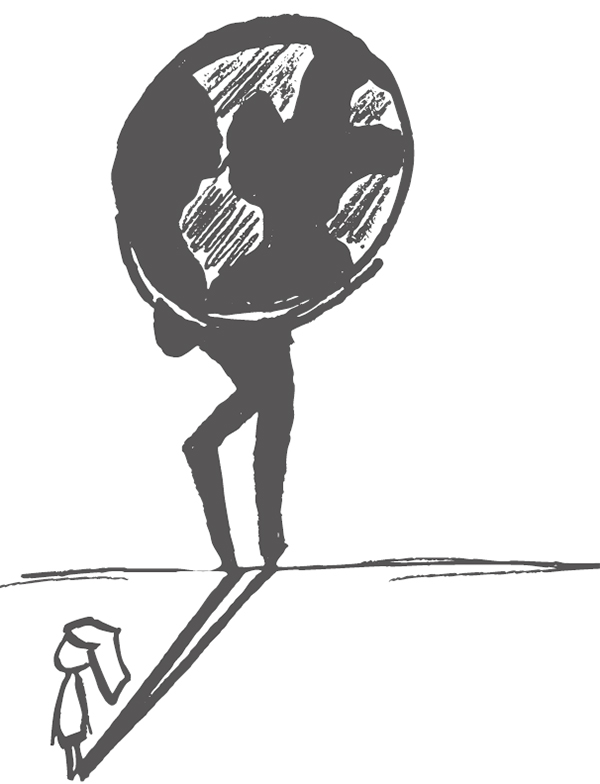
ForewordDear Reader, Whether you’ve acquired this book for personal exploration or as a gift, it will stir within you a curiosity about self-understanding. You might want to ease the restlessness resulting from a job that doesn’t align with your true self, leaving you drained at the end of each day. Or perhaps you aspire to find work where you can truly harness your strengths, stay energized, and realize your full potential. When your desire for change is strong, this awareness becomes your catalyst for initiating the transformation needed to create the life you desire. The book, What Do You Really Want? marks the beginning of an enlightening journey. It serves as the starting point for a remarkable expedition, one where you’ll confront obstacles and acquire tools to address them. Transitioning from one job to another is a multifaceted process that encompasses actions, thoughts, and emotions, as these three aspects are intricately intertwined. Contemplating change can be a daunting task, which is why the true power of change lies in taking purposeful action. Discovering your next career phase and determining the initial steps required, is an educational journey that begins with understanding who you are, recognizing your capabilities, assessing your current activities, and envisioning your desires. Even if you don’t have all the answers right now, and even if you’re uncertain about the destination, trust in the process; it will guide you towards the solutions you seek. The foundation of this book rests upon the Personal Energy at Work (pe@w) model, which initially evolved from my personal challenges. My interest in this subject was sparked by both setbacks and achievements in my own career, driving me to investigate the factors that contribute to an energizing life. I will guide you through various phases of my professional journey, where I encountered periods of job dissatisfaction and sought work that truly resonated with me. It wasn’t until I embarked on my PhD research that I gained a deeper understanding of my own role, and that of my employers. After spending seventeen years in paid employment with major companies, in sales, marketing, and human resources, I made the pivotal decision to put my research findings to the test. I made a significant change by establishing a company offering energy management trainings and personal development programs. Consequently, within this book, you’ll encounter numerous client stories that shed light on how they clarified their desires and conquered the obstacles they faced. Using the pe@w model, this book equips you with practical tools to determine your true aspirations. The chapters demonstrate how your aspirations, combined with your skills, personality, and behavior, form the essential pieces of the puzzle for a dynamic work life. In essence, this book offers you an adventure. My hope is to inspire you, provoke thought, and motivate you to put these tools into action. Chapter 1 The journey of transformationKey insights from this chapter: 1.1 For whom is this book intended? Uncertainty about your desires is a common experience. In fact, it’s something we all encounter periodically; it’s a part of our human nature. Acknowledging that you’re unsure about your wants and understanding this fact is a sign that you’re receptive to growth. Instead of being hard on yourself for seeking answers, embrace the potential that arises from this inquiry. This book is designed for those who aspire to explore different career paths and are in search of their next steps. Can you relate to any of these scenarios? • Uncertainty about what I truly desire. As you gaze into the mirror, the realization dawns on you, it’s time to change direction. You’re prepared for the next phase, yet a clear image of the next phase is missing. What is it that you really want? You long for work that gives you energy rather than depletes your energyConsider a scenario where your work is going smoothly, perhaps even too easily, and you might be operating beneath your skill level. Despite this, a sense of dissatisfaction lingers as you lack the challenge you crave. Even though you can perform the tasks proficiently, you find that joy in your work is diminishing and fatigue sets in by the day’s end. Another situation could be job promotions, each accompanied by status and financial gains. However, the focus on these external rewards may overshadow the importance of assessing whether you truly feel fulfilled in your new role. If post-promotion you discover a lack of job satisfaction, a crucial decision awaits; prioritize status or genuine fulfillment. What should you do when, after years of commitment, you realize that your current job is no longer a good fit? Being in such a position means you’re embodying a persona you don’t wish to be and pursuing a goal that lacks personal importance. This does a disservice, not only to your employer, manager, and colleagues but, most importantly, to yourself. When your work consumes more energy than it provides, it takes a toll. Conflict arises more easily, job satisfaction diminishes, and productivity wanes. You become increasingly fatigued and irritable, with the potential for long-term consequences, such as illness and burnout. Alternatively, you can prioritize your wellbeing. There may come a time, as you get older, when you reflect on your life with regret. In her book, The Top Five Regrets of the Dying (Ware, 2011), Nurse Bronnie Ware shares insights on the most common deathbed regrets. The foremost regret, at No. 1, “I wish I had had the courage to live a life true to myself — not the life others expected of me.” Ware has gained worldwide recognition and her books have reached millions. In her exploration of meaning, she highlights a significant issue: the struggle to authentically choose a path that brings happiness, leading to eventual regret. Regret stands in stark contrast to desire. To avoid future regrets it’s crucial to pursue your desires now, starting today, by shaping your life to align with who you aspire to be. Considering that work constitutes a substantial part of our lives, it’s wise to assess the type of work that resonates most with your desires. You might have attempted the following strategies to take the next step: • Awaiting a quiet moment to contemplate your next move. While these approaches could theoretically lead to action, they often linger as mere thoughts. Now is the moment to embark on the initial steps toward realizing your aspirations. It’s time for a transformation. Understanding your core values and motivations, essentially knowing who you are, unlocks numerous new possibilities. 1.2 The mismatch between the individual and the job Job dissatisfaction commonly stems from a mismatch in one of the 1 Job position (whether the role is above or below your skill level). Mismatch with your job position Conversely, engaging in work below your skill level, where your full potential isn’t utilized, can lead to a bore-out. Professor Dr. Ruth Stock-Homburg states that bore-out manifests through diminishing work motivation and performance, due to prolonged under-stimulation, ultimately resulting in various stress-related psychological and/or physical issues. The three risk factors for developing a bore-out are, boredom, lack of meaningful work, and lack of personal growth (Stock, 2015). In a bore-out, the absence of a challenge in your tasks creates discomfort, causing extreme boredom at work. This doesn’t imply that the workload is low, in fact individuals with a bore-out often find themselves facing an overwhelming amount of work. But it can be work that lacks sufficient mental challenge, and dissatisfaction arises because you know you have more to offer. This situation occurs when you operate at a lower level than your training qualifies you for, or when assigned monotonous and routine tasks. Despite the ease with which you perform the work, a mismatched job can still drain your energy, primarily due to restlessness in your body. Frustration builds as you desire different tasks, yet your current job restricts this. Consequently, bore-out symptoms mirror those of burnout, including stress, fatigue, dejection, and irritability. This can result in sick leave, as the job demands more energy than you can provide. The recognition of bore-out among HR professionals is increasing and is emerging as a primary cause for absenteeism. The solution lies in making your work more stimulating and meaningful, perhaps through training, taking on new responsibilities, and discussing further development opportunities with your supervisor. If these strategies prove ineffective, seeking alternative employment may be the best course of action. Mismatch with your job tasks Mismatch with the company Sometimes people struggle with job dissatisfaction because they’re in the wrong job. They might have become entangled in a sea of confusing tasks or demotivating moments, straying from the original purpose of their work. In either case, it’s a signal that it’s time for a transformation. Embracing change can be challenging, rooted in our primal instinct for security — the need for a stable situation, a predictable income, and clarity about our work expectations. These factors provide a sense of security, which often keeps us in energy-draining jobs. However, the need for change is also inherent in us, the ability to adapt our lives to new situations and survive. If there’s a mismatch between you and your job in any of these areas, it’s time to reflect on your situation and explore ways to create a work environment that suits you. Experiencing a mismatch in any of these aspects is not uncommon, especially in a world with numerous job opportunities. Seeing others on platforms like LinkedIn, thriving in their roles, can spark dissatisfaction with our current situations, prompting new work-related needs to emerge. Over 30 years ago, a forecast was made regarding the nature of a career in the early 21st century (Arthur et al., 1989): • Take full control of shaping your own career. Do these career needs resonate with you? When I came across this list I not only endorsed it, I felt I could enlarge it with up to ten more items for myself. However, if we were to do all of this, our wish list would potentially overwhelm us with possibilities, leading to a feeling of paralysis. Yet, the solution is within reach. You simply need to identify what you truly desire the most, and take the initial step. 1.3 Why it appears challenging Although, at times, we all search for what truly matters in our lives, deep down, a crystal clear desire exists within us. The obstacle preventing you from giving concrete meaning to your desire often stems from a lack of self-knowledge. Deciphering your experiences requires personal exploration, and underestimating your capabilities hinders your ability to investigate what you genuinely want. You seek a job that gives you energy every day, not one based solely on past experiences. Therefore, it’s crucial to identify what brings you energy. The challenge often lies not in identifying your capabilities, but rather in lacking a comprehensive analysis of your personal traits. A common goal for those exploring new career paths, is to attain a better work-life balance. After all, you want enough time for your family and friends in addition to your work, and enough time for yourself to recharge. In the pursuit of balance, many overlook the critical step of questioning how they prefer to organize their lives. Failing to do so may lead to time allocation patterns mirroring those around you. Feeling low on energy and overwhelmed, often results from a belief that there is no alternative. For instance, desiring more frequent vacations but believing it’s impossible. Is it genuinely impossible? Is there no way to adjust your schedule and resources to make it happen? Alternatively, is there another factor at play? If you believe change is unattainable, you may feel like a victim of circumstances. It might be intriguing to explore why taking control and organizing your life to align with your aspirations seems unfeasible. Do you genuinely want to engage in all the activities currently on your plate? Questions that can facilitate insight include: • What am I telling myself I need to do? If your responses to these questions pose no issue, then evidently, you are engaging in activities that bring you happiness. However, if you find yourself contemplating how to attain more balance, it suggests that certain aspects of your life are draining considerable energy. To effectively prioritize your pursuits, you need to answer one crucial question: what do you genuinely want? Once you’ve identified your true desires and unearthed the factors hindering your progress, the subsequent step involves structuring your life to align with your aspirations, enabling you to lead your optimal life. Organizing your life according to your preferences is often less challenging than it may seem. For instance, numerous manuals and apps offer tips on scheduling more free time. However, the key to successfully organizing your work and personal life, lies in having a clear vision of what you really want. How my journey into career development beganMy fascination with career development can be traced back to my eighth-grade year in elementary school. We were informed that a significant test awaited us shortly, determining the high school we could attend. To provide a context, this was The Netherlands 1991, and as yet we hadn’t progressed far in our testing policy. At twelve years old, I had never encountered such a testing concept. I struggled with language difficulties and had a particular fondness for drawing. I received the recommendation to either go to pre-vocational secondary education (mavo in the Netherlands) or senior general secondary education (havo in the Netherlands). This felt like having to decide between these two different types of education, each with its consequences. This required thoughtful consideration of what kind of career I wanted to pursue after high school. What did I want to become when I grew up? As a child, my dream was to become a book cover designer, creating illustrations within books. Though I struggled with reading, I was captivated by the beautiful pictures in books, often creating my own stories.To me, at that time, choosing between the two types of education felt like a “butterfly” effect. The term “butterfly effect” originates from the chaos theory and was a metaphor used by mathematician Edward Lorenz, in 1961, to illustrate how the wings of a butterfly in Brazil could, months later, potentially trigger a tornado in Texas. As a twelve year old and unaware of these concepts at the time, I felt my choice could have either disastrous or magnificent effects on my future and that of many others. Looking back, it’s quite amusing. A young girl strolling across the schoolyard with a shadow the size of Atlas.
Choosing senior general secondary education (havo in Dutch) seemed like a more promising option for me, as I believed it would open up more opportunities, and I successfully convinced my parents to support this decision. Thus began my journey. The initial career tests in the first year of high school captivated me, and from then on, I eagerly embraced every career assessment and test I could find. The results consistently pointed towards my interest in natural sciences and creativity, and in the following years, my intense desire to shape the future was reflected in well thought-out choices.Looking back on it, I find it hard to imagine why I was so afraid of making the wrong choice. Now, I realize that the act of doing teaches, and there’s no such thing as a wrong choice—only lessons learned. If I were to encounter a time machine, I’d go back to reassure my younger self that everything would be okay, encouraging her to let go more. High school was followed by university, where I studies Biomedical Sciences and earned an additional master’s degree in Policy, Management, and Entrepreneurship. While it may sound concise now, those years were filled with hard work, dealing with dyslexia, and juggling side jobs. Learning wasn’t easy and it took considerable time, but my curiosity and enjoyment sustained me.If I had a time machine, I would travel back to my younger self and give her more confidence regarding the future.Following university, my aim was to venture into the business world with a central focus on “making people better.” Securing a valuable internship at the pharmaceutical giant msd (Merck, Sharp and Dohme), I eventually landed my first job as a sales representative. During the initial six years of my career at msd, I experienced a range of positions, each accompanied by moments of enjoyment, setbacks, and victories. As time progressed, I found myself at a crossroads. Despite my ability to handle the challenges, I questioned whether I truly enjoyed the path I had chosen. What did I really want?This reflection coincided with a significant change — a reorganization that led to my redundancy. The resulting period became a fascinating journey marked by resistance, anger, sadness, and eventual acceptance, a tale that could fill an entire book. Entering an outplacement agency opened up a remarkable world for me. I marveled at the opportunity to assist individuals in finding new employment, using scientific models, positive psychology, and meaningful conversations. The idea struck me — what if I could later translate this experience to others, infusing it with a unique touch? However, doubt crept in; I questioned my ability to help others due to a lack of formal training and relevant work experience. Unaware of the concept of limiting beliefs at that time, I embarked on a journey during the outplacement process, to identify my existing skills. Little did I know that eleven years later, I would establish my own company, offering programs in career development and energy management.After conducting a comprehensive analysis of various companies, my interest in delving deeper into the distribution channels of medicinal drugs outside the boundaries of hospitals and pharmacies intensified. Securing the position of marketing manager at a company dealing with both over-the-counter and prescription drugs at drugstores satisfied this curiosity. However, after a few years, doubts began to surface about the alignment of this career path with my aspirations. How was it possible to be valued, surrounded by pleasant colleagues, yet still feel a lack of challenge? This contemplation led me to take on a managerial marketing role, at first with the Danone company and later with Philips. Despite the positive aspects, there were days when I returned home bursting with energy, ready to exercise or socialize. While on other days, I felt drained, lacking even the energy to prepare dinner. Was it a perpetual cycle of things never being good enough?This reflection prompted me to consider the factors that drained energy from one job while leaving me singing on my way home from another. Inspired by a quote from Einstein, “Madness is doing the same thing over and over again, and then expecting different outcomes,” I questioned my own behavior. What could I do differently? This introspection led me to a pivotal decision — to enroll in a part-time PhD program. My goal was to delve into the factors influencing one’s sense of energy at work and to understand the roles of both the employer and the individual.Commencing my research in 2018, I dedicated myself to exploring these dynamics, culminating in the development of the Personal Energy at Work (pe@w) model by the end of 2020. An article detailing the model was subsequently published in a scientific journal, and I proceeded to rigorously test and validate its effectiveness. The results were documented in another published article, and the practical application of this model eventually became the foundation of the book you are reading right now.1.4 Steps to obtain an appropriate work situation Based on my research and conversations with clients, a primary reason individuals find their work energy-draining is the sense of not being in the right place. This reflects Aristotle’s insight, “Energy arises when a person is realizing his potential. Work that suits you does not cost you energy; it gives you energy.” When your work aligns with who you aspire to be, the outcome is a personal gain, fostering a sense of fulfillment. Opting for work that resonates with you involves making sustainable choices that impact your wellbeing, ensuring sufficient energy reserves in the long run. Conversely, persisting in work that doesn’t align with your true self can take a toll on your body, inducing stress and fatigue. Therefore, choosing work that suits you is a sustainable decision with lasting benefits for your health and energy levels. Work that suits you doesn’t cost you energy, but gives you energyA job that resonates with your desired identity not only positively impacts your health but also brings about various advantages: • Engaging in activities you genuinely enjoy daily. To transition from your current job to a work situation that aligns with your aspirations, there are specific steps you can take. Through my research, I’ve identified factors contributing to feeling energized at work. Understanding these factors and your energy dimensions will guide you toward finding work that suits your desired identity. Utilizing the Personal Energy at Work model (pe@w, Klijn et al., 2021), we will navigate the steps toward your ideal work situation.
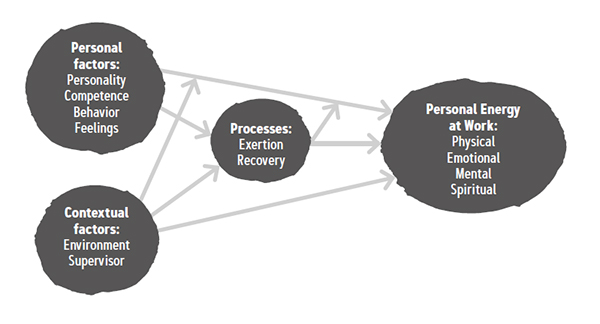
The pe@w model, illustrated in the figure, contains several components. On the far right, the model outlines your personal energy at work, encompassing four dimensions: physical, emotional, mental, and spiritual energy. Physical energy represents the body’s physical state, influenced by factors such as sleep, nutrition, and exercise. Emotional energy pertains to emotions and interpersonal interactions, encompassing feelings of joy, anger, and frustration. Mental energy focuses on cognitive skills, enabling concentration on tasks with a clear goal and minimizing distractions. Spiritual energy represents your self-image, lifestyle aspirations, and is tied to concepts of meaning and fulfillment. Arrows extend from the processes of exertion and recovery, to the block containing the four energy dimensions. Balancing exertion and recovery optimally, allows energy growth across all dimensions. The model further illustrates that personal and contextual factors influence these energy dimensions. Personal factors include your personality (who you are), competencies (what you can), behavior (what you do), and feelings (what you want). Contextual factors encompass your supervisor and environment. The supervisor plays a crucial role in providing support and clarity about your role, while the environment relates to the employer’s vision, work culture, and colleagues. I have conducted studies to validate the pe@w model, and the results indicate a positive correlation between the four energy dimensions and both productivity and health. Additionally, energetic individuals tend to have lower rates of absenteeism due to illness. This underscores the importance of identifying energy drivers and energy drainers in your life. Subsequent chapters will delve into greater detail, about how various factors impact your personal energy at work. 1.5 The career navigation system
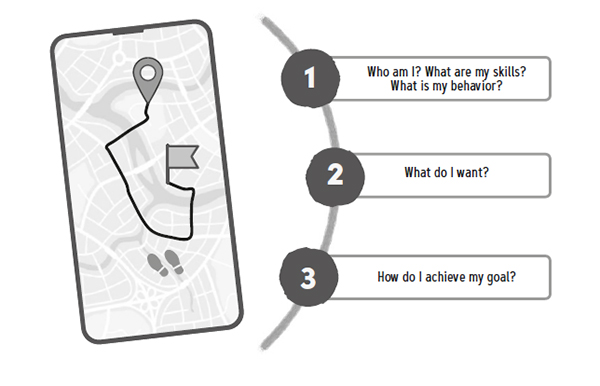
Step 1: Step 2: Step 3: Thomas - Involuntary resignationThomas and I embarked on our careers simultaneously as sales representatives. This is a role in the pharmaceutical industry involving educating doctors about new treatment methods and products. Despite working for different companies, we encountered similar challenges. I can clearly state that being a sales representative was the most challenging job I’ve ever undertaken. I faced substantial resistance, struggled to secure appointments, and often encountered skepticism about my narrative.I recall Thomas saying to me, six months into our jobs, “My employer consistently pushes the boundaries of what I can accommodate and what aligns with my desires. As soon as they go over these limits, it’s enough and I’ll leave. I’ll seek a job that presents the right challenge and offers the support I need.”Our professional paths diverged, with me transitioning to marketing and later to HR, leading to a loss of contact. Approximately twelve years later, Thomas reached out to me. He disclosed that, after remaining a sales representative at the same company, he was now facing forced resignation due to a reorganization. My immediate response was empathy, expressing, ‘Jeez, Thomas, that must be intense. How are you coping?’ With a profound sigh, he conveyed a sense of relief, explaining that he felt liberated.Thomas revealed that the company had increasingly demanded more than he could give, consistently exceeding his limits. For some reason, he kept moving his limits. What had happened? Thomas did not have in mind a clear goal of what he wanted to do. He was dissatisfied in his current position, and he was stuck. Despite his discontent, the benefits of a substantial income provided a sense of security, and whenever he considered alternative jobs, he hesitated, convinced that the grass wouldn’t be greener elsewhere. Consequently, he always came back to his choice to stay in his current position. The company’s decision to let him go lifted a burden from his shoulders, a choice he hadn’t assembled the courage to make himself. Now that the decision had been made for him, it felt good. Very good, in fact. Reflecting on his situation, he acknowledged that he should have left much earlier but had been held back by a lack of bravery.Thomas’ experience resonates with many. When you lack a clear vision of what you do want, you often find yourself staying where you are. This can be likened to the navigation system metaphor — achieving your destination is challenging without a defined endpoint. You may be on the road, but reaching a job that truly suits you becomes difficult. It’s not necessary to have an exact plan before embarking on exploration. It is through experimentation that you discover what aligns with your preferences and what does not. Your desire plays a crucial role in providing direction for these experiments. The key is to uncover what truly matters to you and to gather the courage to take the next step — rather than dwelling on potential consequences, as Thomas did. The initiative is yours, to embrace your desires, set a point on the horizon, and start your journey. 1.6 How to read this book In the upcoming chapters, you will explore the factors influencing your personal energy and discover how understanding your energy drivers and energy drains can guide you towards the right job. The chapters provide both theoretical insights and practical tools to help you discern your true desires and find a job that suits you best. Chapter 2 delves into the various energy dimensions, offering tips on how to enhance your overall energy levels. Chapter 3 revolves around personal core values and their role in enriching your desires. The book includes a core values test located at the end of the book. Chapter 4 focuses on the personal factors contributing to an energetic work life. It provides practical advice on self-discovery, exploring who you are, what you can do, and what you do. Chapter 5 explores your mission and desires, shedding light on the role of leaders and your environment, in shaping your aspirations. Chapter 6 guides you towards your goal, offering insights into the initial steps you can take to change your course. Chapter 7 serves as the conclusion, summarizing the key points from all the chapters and providing the final motivation you need, to choose a job that offers meaning, energy, and the right challenge. Key takeaways from this chapter: 1 Doing work that suits you gives you energy. Doing what doesn’t suit you costs energy. Reflective Questions: • On a scale of 1 to 10, how much satisfaction do I derive from my current job? |
Click here to download the preview as a pdf file |
Order the book at Amy en Eva | Amazon | Managementboek.nl | bol.com | Libris.nl | Bruna.nl | Zoek een boek | Athenaeum/Scheltema | Donner |
| Back to the book | More information on the author |
|